Meet Victron’s new kW-rated VE.Bus inverters
Transformer-based inverter/chargers, new watt-based model names, and a path from compact systems to 240 kW designs and 400 kW off-grid Native Microgrids.
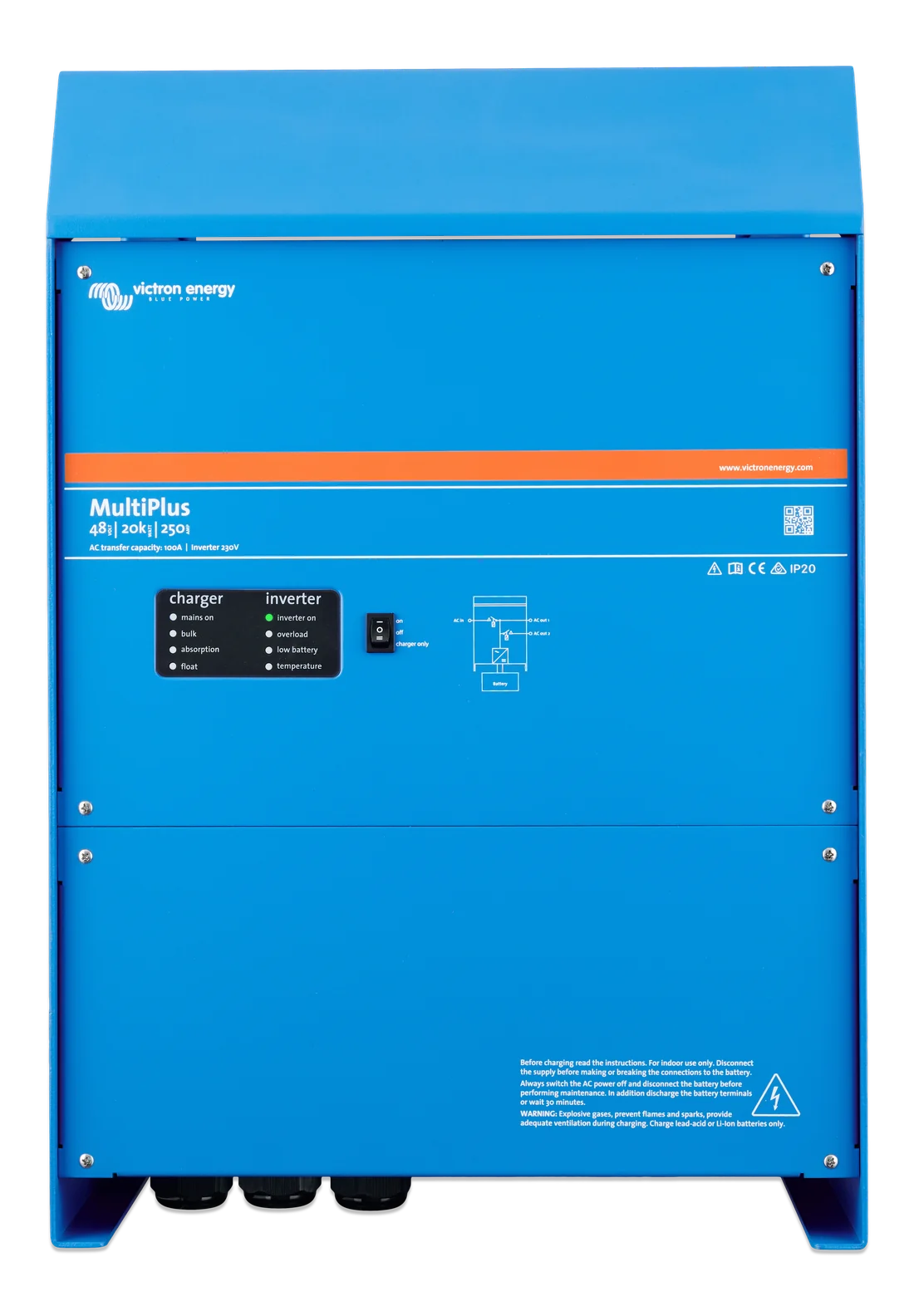
Victron’s newer VE.Bus inverter/chargers give buyers something useful to look at: watt-based model names, more choices for different applications, and a route to much larger power systems. The additions include compact 12V equipment, several 48V MultiPlus-II models and the substantial MultiPlus 20k.
For us, the interesting part is choosing equipment that fits the job and can be supported afterwards. A mobile installation, a workshop and a large off-grid site need different designs. These additions broaden the conversation, while keeping the familiar Victron approach to monitoring, configuration and technical support.
Transformer-based power, with VE.Bus coordination
These are low-frequency, transformer-based inverter/chargers. Victron’s manuals for the new MultiPlus-II models and MultiPlus 20k identify mains-frequency isolating transformers. VE.Bus is the communication system used to coordinate compatible units and connect them to system monitoring.
An inverter/charger combines battery-to-AC conversion, charging from an AC supply and transfer functions. The complete system still needs the appropriate battery, protection, solar-charging arrangement and controls. Starting a pump, running a compressor and supplying steady electronic loads are different duties; the load profile belongs in the equipment selection.
Why the new names use kW instead of VA
Many established Victron models use volt-amperes, or VA, in their size designation. VA describes apparent power; watts describe real power delivered to the load. Power factor affects the relationship. Victron explains the newer watt-based naming in its inverter/charger selection guide.
A familiar example is the established MultiPlus-II 5000VA: its datasheet specifies 4,000W continuous output at 25°C. That is why comparing a legacy “5000” with a new watt-based model by the number alone can mislead. Read the full model designation and the continuous-output specification.
Also keep kW and kWh separate. The inverter’s power capability helps determine which loads can run together. The battery’s usable energy helps determine how long they can run. Battery discharge limits and the installation must support the intended power.
Which new models are published?
The current 230V sheets list these new kW-labelled additions at 12V and 48V. Established 24V equipment remains in the wider VE.Bus family; check the voltage of your chosen model.
| Model / battery voltage | At 25°C | At 40°C |
|---|---|---|
| MultiPlus-II 12/4k/160-32 | 3.4 kW | 3.1 kW |
| MultiPlus-II 48/4k5/55-32 | 4 kW | 3.7 kW |
| MultiPlus-II 48/6k5/100-50 | 6 kW | 5.7 kW |
| MultiPlus-II 48/10k/150-100 | 10 kW | 9.1 kW |
| MultiPlus 48/20k/250-100 | 20 kW | 18 kW |
Sources: new MultiPlus-II model datasheet and MultiPlus 20k datasheet. These are published specifications, not a statement of local stock.
There is an important naming detail: the 4k5’s 4.5kW and the 6k5’s 6.5kW are time-limited outputs from a cold start. Their continuous ratings at 25°C are 4kW and 6kW respectively. Temperature and the duration of a load matter. Ask for a design against the continuous duty and starting demand you actually have, with suitable margin for a warm KZN equipment room.
From one 20kW unit to a 240kW system
Victron’s external-transfer-switch application supports up to twelve compatible units, with a maximum of four per phase. Using twelve MultiPlus 20k units in three phases gives 240kW of aggregate inverter capacity on the 25°C rating basis: four units per phase, or 80kW per phase.
This configuration needs the specified external switching, measurement, protection and application firmware. The overall design must account for temperature, phase loading, batteries, charging and site requirements. The twelve-unit total does not mean one phase can supply the entire 240kW.
Grid-parallel projects need particular care. The standard 20k installation manual contains a 30kW aggregation warning at a single point of common connection. Obtain confirmation of the applicable external-transfer architecture, grid protection and local approval route before quoting a larger grid-connected installation.
Beyond one VE.Bus system: Native Microgrid up to 400kW
For larger off-grid sites, Victron’s Native Microgrid architecture currently supports a total inverter output of up to 400kW across all Power Banks. Each Power Bank has its own VE.Bus system, battery and DC side. The banks share an AC network and coordinate through voltage/frequency droop.
The native installation requirements are specifically off-grid, with independent DC-side charging. Public-grid connections, AC solar inverters and directly paralleled generators are outside that native AC-bus arrangement. A generator charging strategy needs to be designed for the supported architecture.
Modular banks can support expansion and resilience, provided the remaining equipment has enough capacity when a bank is unavailable. Battery state of charge is not automatically balanced between banks. The current 400kW support limit describes the Native Microgrid option; it is not a general ceiling for every type of Victron microgrid project.
Choose the equipment and the support together
Our starting questions are practical: what must run, what starts together, how long must essential loads remain powered, and what should the site be able to do later? Send the battery voltage, single- or three-phase supply, existing equipment, grid/generator arrangements and any expansion plans. A load record is more useful than a single large number on a quotation.
At Thanda, we put quality products together with local support, training and repairs. Where an application needs manufacturer clarification, we can help frame the technical question and escalate it. That matters when selecting the exact model, planning an expansion or working through a difficult fault.
Speak to our Ballito team about the model and complete system you need. We will confirm availability and quote the appropriate equipment; a product introduction is the beginning of that conversation.
Further reading from Victron
Technical guidance and manufacturer documents for the equipment and principles discussed here. Use the documentation for your exact model and system.
- Victron inverter/charger selection guide — watts, VA and VE.Bus
- MultiPlus-II 4k, 4k5, 6k5 and 10k — current 230V datasheet
- Established MultiPlus-II 230V models — VA and continuous watts
- MultiPlus 48V 20k — current datasheet
- New MultiPlus-II manual — mains-frequency transformer
- MultiPlus 20k installation — connection and aggregation requirements
- External Transfer Switch application — compatibility and system size
- Native Microgrid — functionality and current 400kW scope
- Native Microgrid — installation and charging requirements
- Victron Microgrid overview — native and controller-based architectures